

Craig Callahan, DBA
Founder & President,
Chairman of the ICON Investment Committee
- Portfolio Manager of the ICON Fund, ICON Opportunities, and Long/Short Fund; Co-Portfolio Manager of the ICON Risk-Managed Balance Fund
- Created ICON’s proprietary valuation model
- Founded ICON in 1986
I have some good news and some bad news. Which do you want first?
Craig Callahan, DBA
February 22, 2016
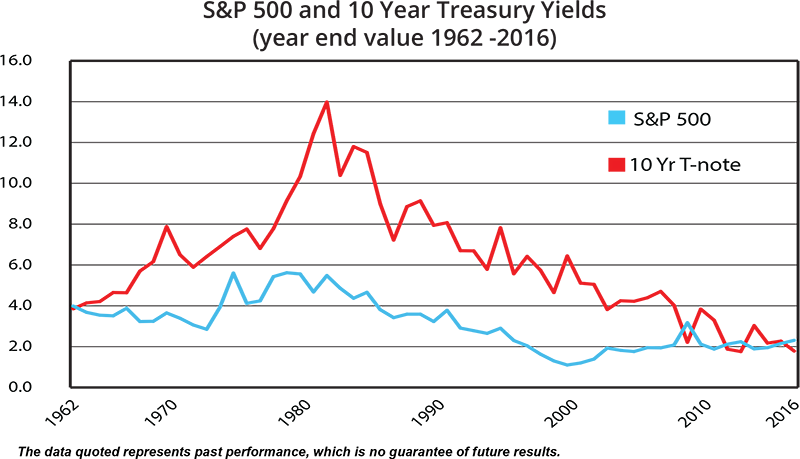
The graph below shows the dividend yield on the S&P 500 Index and the yield on the 10-Year U.S. Treasury Note (the Treasury Note) for December 31 of each year starting 1962. Typically, the yield on the Treasury Note is greater than the yield on the S&P 500 Index. Interest payments on Treasury Notes are fixed over the life of the note, whereas dividends on the S&P 500 Index have a history of growth. In fact, S&P 500 Index dividends have grown at a 5.97% annual pace since 1994. Logic would dictate that to entice investors to accept a fixed yield over growth potential, the market would have to offer investors a higher yield. Thus, it would be unusual to see a higher yield and growth potential in the same instrument over a fixed yield that is lower. While unusual, it is happening currently, for only the fifth time since 1962 when analyzing data for December 31 of each year. As of February 19, 2016 the yield on the 10-Year Treasury note was 1.749% while the dividend yield on the S&P 500 Index was 2.31%.
Interestingly, the other four times the dividend yield on the S&P 500 Index exceeded that of the 10-Year U.S. Treasury Note at year end (1962, 2008, 2011, and 2012), the stock market moved higher over the next year and beyond. All of those previous instances were accompanied by uncertainty and worrisome news events. The uncertainty in 1962 revolved around the Cuban Missile Crisis, 2008 was the Great Recession and financial crisis, and 2011 and 2012 featured concerns over European sovereign debt. We see the current unusual yield environment as an indicator that stocks, in general, are cheap for a variety of reasons, ranging from concerns about China’s economy to fallout from the drop in the price of oil. The old relationship seems intact – good bargains come with bad news.
For more value insights subscribe here ICON’s Sales Desk.
Past performance does not guarantee future results.
Opinions and forecasts are subject to change at any time, based on market and other conditions, and should not be construed as a recommendation of any specific security, industry, or sector.
Investing in securities involves risks, including the risk that you can lose the value of your investment. There is no assurance that the investment process will consistently lead to successful results. Investing in fixed income securities such as bonds involves interest rate risk. When interest rates rise, the value of fixed income securities generally decreases.
The 10-year yield is the benchmark 10-year yield to maturity reflected by the current issue 10 year U.S. Treasury note. The unmanaged Standard & Poor’s (S&P) 500 Index is a market value-weighted index of large-cap common stocks considered representative of the broad market. Individuals cannot invest directly in an index.
Source: Factset
Please visit ICON online at www.iconadvisers.com or call 1-800-828-4881 for the most recent copy of ICON’s Form ADV, Part 2.

